No, you should not mix different types of coolant. Fluid management for your vehicle is essential to prolonging the engine's life. Coolants have different chemistry formulations, like an older IAT formula with a modern OAT coolant. When you mix them, the additives can react with each other and cause more damage than running with no coolant at all.
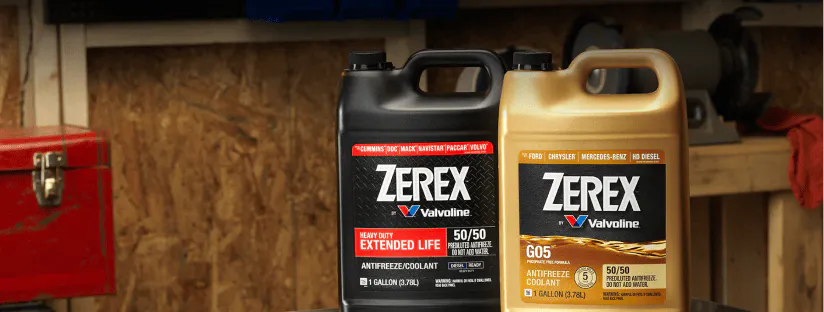
The right move is always to match your factory fill, flush completely before switching, and never guess based on color alone. Zerex G48 Concentrate Antifreeze from Valvoline is engineered to meet OEM specifications, so you never have to guess.
01The Difference Between IAT, OAT, and HOAT Coolant
There are three types of coolant categories, and they share a common base. The base is usually ethylene glycol mixed with water. What makes them different is the package of additives used to fight corrosion. Those additives are not interchangeable, and that's where problems start when people mix types.
IAT (Inorganic Additive Technology) is the old-school (often green) coolant most people recognize from older vehicles. It uses silicates and phosphates that form a protective film on metal surfaces to prevent rust and corrosion. The catch is that those silicates deplete quickly. IAT is generally changed about every 2 years or 30,000 miles (some auto manufacturers specify different intervals) or it can turn acidic, and protection weakens.
OAT (Organic Acid Technology) is commonly used in modern passenger vehicles. Instead of forming a full protective coating, it uses carboxylate-based organic acids that react at corrosion sites as they develop. This approach works well with modern aluminum and mixed-metal engines and allows for longer service intervals—typically up to 5 years or 150,000 miles. (Check your owner's manual for the correct interval). Most OAT coolants are free of silicates and phosphates, and their additive chemistry is fundamentally different from traditional IAT, which is why they should not be mixed.
HOAT (Hybrid Organic Acid Technology) blends elements of both. It adds a small amount of silicates or phosphates into an OAT base to get better corrosion resistance without sacrificing longevity. As SAE International's coolant standards documentation explains, HOAT is commonly found in European vehicles (like BMW, Mercedes-Benz, and Porsche) and in many Asian-brand vehicles under sub-types called P-HOAT and Si-OAT. HOAT typically lasts 5 years or 100,000 miles, though some formulas go may longer.
Use this table as a quick-reference comparison of the three main coolant technologies:
| Feature | IAT (Inorganic) | OAT (Organic Acid) | HOAT (Hybrid) |
|---|---|---|---|
| Common Color | Green (but color varies) | Orange, red, or pink (varies) | Yellow, turquoise, or purple (varies) |
| Protection Method | Silicate/phosphate coating on all surfaces | Targets active corrosion sites only | Combines OAT base with limited silicates |
| Typical Vehicles | Pre-2000 domestic vehicles | Many modern passenger cars (GM, VW) | European (BMW, Mercedes), many Asian brands |
| Change Interval | Every 2 years / 30,000 miles | Up to 5 years / 150,000 miles | Typically 5 years / 100,000 miles |
| Aluminum Compatibility | Moderate (silicates can be abrasive) | Excellent (designed for modern aluminum engines) | Excellent |
| Key Limitation | Silicates deplete quickly, requiring frequent changes | Cannot mix with IAT; lacks silicate protection | Varies by sub-type (P-HOAT, Si-OAT) |
Note: Color is not a reliable indicator of coolant type. Always check the label or owner's manual for the correct specification.
02What Actually Happens When You Mix Incompatible Coolants
This is not the time to pour in a coolant fluid and say, I'm sure it will be fine. Mixing incompatible coolant chemistries can cause real, expensive damage, and it usually happens silently before you notice anything is wrong.
The two biggest risks are gel formation and accelerated corrosion. When OAT and IAT additives mix, the chemistry can break down and cause what's called "additive dropout." The inhibitors fall out of suspension and form a thick, gel-like sludge.
Gel that is supposed to be a runny liquid is a bad sign. That gel can clog your radiator, heater core, and coolant passages, starving your engine of the cooling it needs. As SAE International notes, some coolant mixtures also create corrosive acids that eat through seals and metal components.
The second risk is reduced corrosion protection. Even if the coolants don't visibly react, mixing dilutes the inhibitor concentrations in both formulas. Your cooling system ends up with a hybrid that doesn't do either job properly. It won't protect aluminum the way OAT does, and it won't protect cast iron the way IAT does.
It isn't always easy to spot the damage from mixing coolants. It shows up slowly through brown or rusty-looking fluid in the reservoir, a heater that never goes past warm, or an engine that runs hot. By the time you notice, the internal damage is already done.
03Coolant Color Is Not an Indicator of the Type of Coolant
Looking at the coolant color to find out which type of coolant is not reliable, and it is a myth that many people buy into. You cannot figure out what kind of coolant it is by looking at it. Green does not mean IAT. Orange does not mean OAT. Pink does not mean Asian-spec.
Color is just a dye that manufacturers add. There is no universal color standard, and the same color can represent completely different chemistries from different brands – it tells you nothing about the inhibitor package inside.
Two jugs of orange coolant sitting next to each other on a shelf could be completely incompatible. Two jugs of green coolant could have entirely different formulas. BMW uses blue coolant. Toyota uses red/pink. Neither color means anything about what's actually in the formula.
The only reliable guide is your vehicle's owner's manual. It will specify the exact coolant type, OAT, HOAT, P-HOAT, and Si-OAT that your cooling system was designed around. Stick to that spec every single time.
04When Should You Replace Your Factory Fill Coolant?
When your coolant is first filled at the factory, you have a little extra time before you have to change it, because manufacturers use higher-quality inhibitor packages and want the vehicle to appear low-maintenance during its warranty period. But that long first interval doesn't mean coolant lasts forever.
Always consult your owner's manual. General guidelines by coolant type:
- IAT coolant: Every 2 years or 30,000 miles, it degrades quickly and can become corrosive if left too long
- OAT coolant: Up to 5 years or 150,000 miles in most passenger vehicles, but this doesn't mean you skip checks
- HOAT coolant: Typically 5 years or 100,000 miles, though some formulas are rated longer
The National Highway Traffic Safety Administration (NHTSA) recommends inspecting coolant regularly, not just at change intervals.
Discolored or murky coolant can indicate contamination or depleted additives, and it's a good sign the system should be serviced regardless of mileage. A noticeable sweet smell under the hood often points to a coolant leak and should be checked promptly.
Keep in mind that draining the radiator typically removes only part of the coolant, with a significant amount remaining in the engine and heater core. For a complete service – especially when switching coolant types – a full system flush with distilled water an effective way to remove old fluid and contaminants before refilling.
05Choosing the Right Coolant for Your Vehicle
Pull out your owner's manual and see what the manufacturer specifies for the coolant type. The manual will sometimes include the exact OEM formulation that was intended for your car's engine. Following that spec is the only way to guarantee compatibility with your water pump seals, radiator metals, heater core, and engine block.
If your manual isn't handy, check what's currently in the system (not just the color; look for a label on the coolant reservoir or in the last service record). When in doubt, the Valvoline product quiz can help you identify the right formula for your vehicle's year, make, and model.
Zerex G48 Concentrate Antifreeze uses NAP-free Hybrid Organic Acid Technology (HOAT) in an ethylene glycol base, making it the right choice for BMW, Mercedes-Benz, Mini, Volvo, and many Chrysler and Ford vehicles. It protects all cooling system metals from corrosion and guards against hard-water deposits, without phosphates or nitrites that could react with the wrong system.
Valvoline has been solving engine protection challenges since 1866. Just as we designed the right full synthetic motor oil for each engine's needs, Zerex coolants are built around OEM specs, not guesswork.
06What Should You Do If You've Already Mixed Coolants?
Don't panic if you've already mixed coolants, but don't wait. If incompatible coolants were mixed, flush the system as soon as possible before gel or corrosion damage can progress.
Stop driving if you notice overheating, gel in the reservoir, or discolored coolant
Drain the system, but draining only removes about half the fluid
Flush with distilled water multiple times until the fluid runs completely clear
Refill with the correct coolant type as specified in your owner's manual
Monitor your temperature gauge over the next few drives for signs of lingering issues
A professional pressure test can identify leaks in the radiator, hoses, water pump, or other cooling system components. If leaks are found, further inspection is needed to determine whether corrosion or another issue is the underlying cause.
07Coolants FAQ
Can you mix coolants in an emergency?
No, do not mix coolants, even in an emergency. If you're stranded and need to top off, distilled water is always safer than adding the wrong coolant type. Water will dilute your protection temporarily, but it won't trigger a chemical reaction. Once you are through the emergency, flush the fluid, and fill it with the correct coolant.
How do I know if my coolant has gone bad?
When coolant goes bad or has degraded, it may look brown, murky, or rusty instead of clear and bright. You might also see floating particles or gel-like deposits in the reservoir. A sweet smell from under the hood, especially after driving, can indicate a leak. If your temperature gauge is creeping higher than normal, low or compromised coolant is one of the first things to check.
Does the 50/50 antifreeze-to-water ratio matter?
Yes. A 50/50 mix of antifreeze concentrate and distilled water is the standard for most climates. It raises the boiling point to around 265°F and lowers the freezing point to approximately -34°F. Going heavier on antifreeze (more than 70%) actually reduces protection and hurts heat transfer. Always use distilled water, not tap water, which can leave mineral deposits in the system.
Does coolant affect engine performance beyond temperature?
Yes. Coolant is doing more than regulating temperature; it's actively protecting aluminum heads, iron blocks, water pump seals, and radiator cores from corrosion every time the engine runs. Degraded or wrong-type coolant means inadequate corrosion protection, which can cause leaks, seal failure, and internal buildup long before you ever see a temperature warning light.
08Why Coolant Compatibility Matters
You may think different types of coolants and antifreezes are interchangeable, but they are not. And mixed fluids will damage your vehicle over time. The wrong fluid mixture can reduce cooling efficiency, cause chemical incompatibility, and increase the risk of corrosion or sludge buildup in your engine. Since different coolant formulations use distinct additive technologies, combining them can weaken their protective properties and compromise long-term system performance.
For the best results, always use the coolant type specified in your owner's manual and avoid mixing products unless they are explicitly labeled as compatible. When in doubt, a full flush and refill with the correct formulation is the safest way to protect your cooling system and prevent costly repairs down the road.
Valvoline has been protecting engines since 1866. Find the right coolant for your vehicle with Zerex G48 Concentrate Antifreeze, and explore our full lineup of engine protection products at shop.valvolineglobal.com